The first person who truly sees your vision can change what you believe is possible.
By John Diehl, Co-Founder of swapup · 7 min read
There is a lonely stage in almost every dream.
You are the only one thinking about it.
You wake up with it. Rewrite it. Question it. Defend it. Carry it through workdays, setbacks, distractions, and all the moments when life gives you a perfectly reasonable excuse to put it away.
Other people may hear the idea. They may even tell you it sounds wonderful.
But then something different happens.
One person does not stop thinking about it when the conversation ends.
They come back with questions. Then ideas. Then a plan. They begin saying we instead of you.
That is the moment your dream gains a second brain.
When an idea crosses into another mind
For years, swapup lived primarily in the mind of one person.
It was imagined, reconsidered, scrapped, rebuilt, and documented through dozens of business-plan revisions and platform-blueprint updates. The vision kept growing—but all of that growth was still being carried by one brain.
Then my co-founder, Faraz, had time to absorb the bigger picture.
He read the plan while traveling. He saw how the pieces connected. He understood what People Helping People could become. And when he returned, he said something every dreamer hopes to hear:
“I can’t stop thinking about it.”
Soon, he was not just attending meetings. He was building a development plan, defining the engineering path, and thinking about problems I could not solve the way he could.
The work did not merely become lighter.
The dream became larger, clearer, and more real.
swapup Insight
The first collaborator does more than divide the work. They prove that the dream can live in a mind other than your own.
That is not proof that the market will say yes. But it is a powerful form of validation: proof that the idea can cross from one person to another, survive serious thought, and inspire meaningful commitment.
The right collaborator should not be another version of you
It is tempting to search for someone who thinks exactly as you do.
But a strong collaborator is not your echo.
They bring a strength your dream needs and you do not naturally possess. A visionary may need a builder. A gifted craftsperson may need someone who understands customers. A numbers-driven planner may need a storyteller. A community leader may need an operator who can turn relationships into a repeatable system.
The point is not that one person is complete and the other is incomplete.
The point is that different strengths can serve the same purpose.
The right collaborator may:
See risks your excitement causes you to miss.
Create structure around an idea that still feels enormous.
Challenge assumptions without diminishing your belief.
Carry responsibility instead of waiting for instructions.
Keep thinking when you are tired, stuck, or focused elsewhere.
Turn your energy into momentum—and return energy when yours runs low.
You do not need someone who can do everything you can do.
You need someone who can help the dream do what you cannot do alone.
Belief changes the person carrying the dream
When someone capable chooses to invest their time in what you are building, it does something inside you.
You feel seen.
The years of private thought no longer feel invisible. The idea is no longer something you must constantly explain to yourself. Another person recognizes the possibility—and is willing to place part of their own life beside it.
That creates confirmation, responsibility, and momentum all at once.
But real collaboration is more than encouragement. A cheerleader believes in you. A collaborator believes enough to accept ownership.
That is when casual conversations become working sessions. “We should” becomes “I will.” The next meeting becomes a development plan. The dream begins acquiring deadlines, decisions, responsibilities, and train tracks.
Before you know your direction, life can feel like a road with endless turns. Every option competes for your attention.
Purpose begins to remove some of those turns.
Once you know where you are going—and build the right track toward it—you stop negotiating with every passing road. You still adapt. You still learn. But your energy finally has somewhere to travel.
Do you know what your dream actually needs?
Before you search for a collaborator, become honest about the gap.
Ask yourself:
What am I uniquely able to bring to this dream?
Name the strengths, experience, relationships, creativity, or conviction that make your role essential.
What part of the dream repeatedly slows down without someone else?
Look for the work you avoid, cannot perform well, or should not pretend to understand.
What values must another person share?
Skills can complement one another, but conflicting values can break the partnership.
What small piece could we build together first?
Trust should be tested through action before it is assumed through enthusiasm.
Do not begin with, “Who will save this idea?”
Begin with, “Who could strengthen it—and what can I contribute in return?”
The best collaboration is not one person borrowing another person’s ability. It is two people becoming more capable because they are building together.
What if you have not found your purpose yet?
Some people can name their dream immediately. Others only feel a quiet restlessness—the sense that their abilities, experiences, or energy are meant to lead somewhere they have not yet identified.
Not knowing your purpose does not mean you do not have one.
It may mean you have not spent enough time noticing what gives you energy, what problem you cannot ignore, what kind of work makes time disappear, or whose life you feel called to improve.
Purpose is not always discovered in one lightning-bolt moment.
Sometimes it is uncovered through learning. Sometimes through service. Sometimes through hardship. Sometimes another person sees a strength in you before you know how to name it yourself.
That is another gift of a second brain: the right person does not only help you see the dream more clearly.
They may help you see yourself more clearly too.
One small action for today
Write your dream—or the problem you feel drawn to solve—in one sentence.
Then make two short lists:
What I bring
What the dream still needs
Do not search for a title such as “co-founder,” “partner,” or “mentor” yet. Search for the missing strength.
Think of one person whose values you trust and whose abilities complement yours. Invite them into one honest conversation. Explain the vision, ask what they see, and listen closely to what they continue thinking about after the conversation ends.
You do not need an entire team to begin.
Sometimes the most important change is simply going from one brain to two.
Your journey does not have to look like anyone else's
We are all on our own journey, and each of us finds the right direction in our own time. You may already know the dream that pulls you forward. You may still be trying to name it. You may simply know that there is more potential inside you—and more good you want to bring into the world.
Wherever you are, you do not have to have every answer before you begin.
You also do not need to wait until you have more money, a perfect plan, or complete confidence. Getting started with swapup is free. This is your opportunity to learn more about yourself, discover what you can offer, meet people who may help you grow, and take one useful step toward the person you want to become. There is no perfect time to begin your personal growth. There is only the moment when you decide that your potential is worth exploring.
You may not need a collaborator first. You may need a mentor—someone in the community who has walked a similar road, can recognize strengths you have not yet learned to see, and can help guide you toward the path that is right for you. The right mentor does not choose your direction for you. They help you see your possibilities more clearly and take the next step with greater confidence.
swapup exists to help people discover their potential, move closer to their purpose, and connect with the people, mentors, knowledge, and opportunities that can help them grow. Sometimes that journey begins with a new skill. Sometimes it begins by helping someone else. And sometimes it begins when another person sees something in you—or in your dream—that you are finally ready to see too.
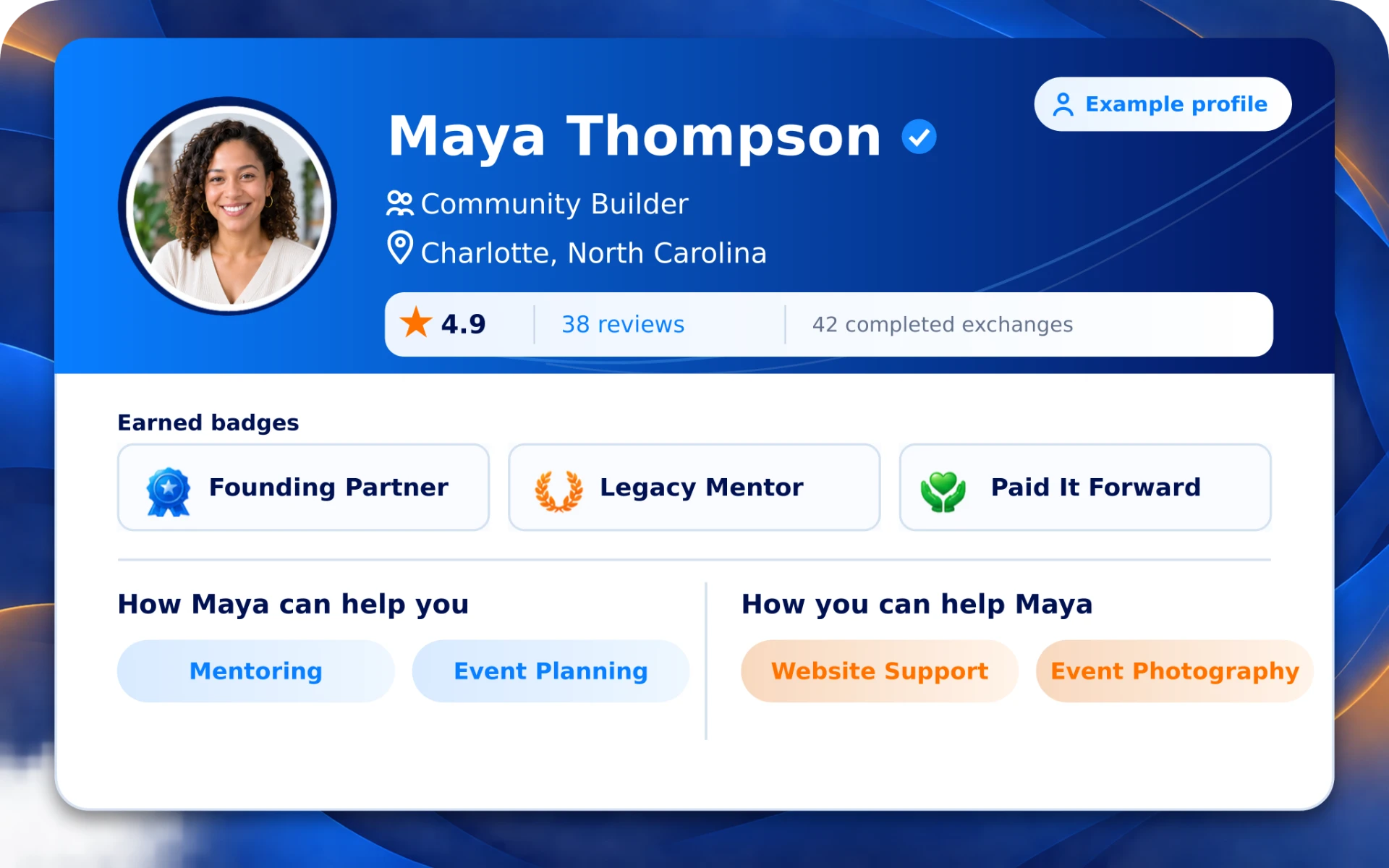
Your Community Profile is where that growth can begin to take shape. It is not a score and it is not a place to pretend that you have everything figured out. It is a living reflection of the skills you develop, the people and communities you connect with, the commitments you keep, the ways you contribute, and the experiences that help you become stronger. After this letter, read Your Community Profile: Let Your Actions Introduce You to see how your actions can tell your story, how you can contribute, and how the community can help you keep growing.
Thank you for taking the time to read this letter, and thank you for being here. We're glad you found your way to swapup, and we welcome you to get started. Joining is free. Your growth, your purpose, and what you may be able to bring into another person’s life are worth discovering.
Now, let’s take the next step in your journey—and discover what your Community Profile can become.
A moment to reflect
What could become possible if one capable person began carrying this dream with you—and what would you need to offer them in return?
Keep reading
Open access — free to read, no account needed
5 min read
Trust & relationships
Your Community Profile: Let Your Actions Introduce You
Your profile is more than a bio — it's a chance to show up, build trust, and attract the right connections.