
Open access — free to read, no account needed
4 min readPurpose & contribution
The Ripple Effect
You may never know the impact one small act of kindness can have by helping just one person.
Read article — The Ripple EffectTrust & Relationships
The front porch was more than architecture. It was the small stage where a neighborhood learned how to know itself.
By swapup · 6 min read
There was a time when the front porch was one of the most important rooms in the house.
It was where people drank coffee before the day began.
Where children played within earshot.
Where someone shelling peas, fixing a bicycle, or reading the newspaper could look up and wave.
Where a neighbor walking past might stop for two minutes and stay for twenty.
Nothing had to be scheduled.
Nobody needed an invitation, a group chat, or three possible dates for a conversation.
People simply became part of one another’s lives because life was happening where it could be seen.
Then, little by little, the porch lost its place.
And we lost more than a place to sit.
A front porch occupied a strange and valuable piece of territory.
It belonged to the home, but it faced the world.
You could be comfortable without being hidden. Available without formally hosting. Alone without being completely isolated.
That made connection easier.
A person walking a dog could say hello without feeling intrusive. A new neighbor could introduce themselves without knocking on a closed door. Someone could notice that an older resident had not collected the newspaper—or that a family might need an extra pair of hands.
These were not always deep friendships.
Often, they were something simpler: recognition.
You knew the man two houses down worked nights. You knew which child belonged to which parent. You knew who grew tomatoes, who owned a ladder, who had just moved in, and who could probably tell you why your lawn mower would not start.
Researchers studying porch use have found that although it declined over time, porches still provide a natural setting for talking with neighbors and watching the life of the neighborhood. Other research has linked positive neighborhood features—including porches and sidewalks—with stronger neighborliness. Front-porch study, neighborhood-design study
The porch did not create perfect communities.
It simply created more chances for people to become familiar.
And familiarity is often where trust begins.
There was no single moment when front porch culture disappeared.
The way people lived gradually changed.
Air conditioning made the inside more comfortable. Television and later digital entertainment gave families more reasons to remain indoors. Cars moved entrances toward garages and back doors. Private decks and fenced yards pulled leisure away from the street. Work, commuting, activities, and packed schedules left less time to sit without accomplishing anything.
Many newer porches became decorative—wide enough for a package, but not for a conversation.
Our homes became more private.
Our lives became more convenient.
And fewer people could see one another living them.
Research comparing older and newer neighborhoods found that porch size, attractive backyards, and lifestyles that no longer support porch use can all pull people away from the front of the home. Research on changing porch use
None of those changes is automatically bad.
Privacy matters. Safety matters. Rest matters. Nobody should have to be socially available every time they step outside.
But when every part of life moves behind a door, a fence, a screen, or a steering wheel, spontaneous connection becomes rare.
Then we wonder why we can live twenty feet from someone for five years and still not know their name.
We tend to think community is built through major events.
Block parties.
Festivals.
Volunteer days.
Neighborhood meetings.
Those things help. But strong communities are often built through much smaller moments.
The wave from the driveway.
The borrowed tool.
The five-minute conversation after work.
The extra vegetables left on a neighbor’s steps.
The person who notices you are struggling with a heavy box and walks over.
These interactions seem insignificant because no single one transforms a neighborhood.
But they accumulate.
You begin by recognizing a face. Then you learn a name. Then you exchange a small favor. Then, when something important happens, you are no longer asking a stranger.
The U.S. Surgeon General’s work on social connection emphasizes that relationships and community ties are not merely pleasant additions to life; they are important to individual and community well-being. U.S. Surgeon General’s social-connection guidance
The front porch helped create those ties without making them feel like work.
Not everyone has a porch.
Some people live in apartments, townhomes, rural properties, high-rises, or neighborhoods where sitting outside does not feel comfortable or safe.
The answer is not to romanticize one kind of home.
It is to understand the function the porch served.
The porch made people:
That function can exist in many places.
An apartment courtyard.
A shared garden.
A dog park.
A library.
A neighborhood coffee shop.
A school pickup line.
A community center.
A bench near a walking trail.
A recurring farmers market.
A group of folding chairs in somebody’s driveway.
A systematic review of public-space research found that places designed to support social interaction can strengthen a sense of community. Public-space and community review
Sometimes community begins with architecture.
More often, it begins when somebody decides to use a space differently.
You do not have to become the mayor of your neighborhood.
You do not need to organize a giant event or force conversation with people who want privacy.
You can begin by making one small interaction easier.
Sit outside for ten minutes instead of scrolling inside.
Learn one neighbor’s name.
Bring an ordinary activity where people can see it: repot a plant, tune a guitar, work on a bicycle, sketch, read, or drink your morning coffee.
Ask the familiar face at the coffee shop what their name is.
Offer extra herbs from the garden.
Invite two people for a walk instead of waiting until you can host a perfect dinner.
Post a specific, low-pressure invitation: “I’ll be working in the community garden Saturday morning if anyone wants to join.”
The goal is not constant access to one another.
It is a small opening through which connection can begin.
Technology is often blamed for weakening neighborhood relationships.
Sometimes that criticism is fair.
But technology can also help rebuild the introduction that modern life no longer creates naturally.
It can help the person with extra tomato plants find the neighbor who wants to learn gardening.
It can help parents discover a weekend activity nearby.
It can help someone new to town find a walking group, a community event, a mentor, a local business, or another person who shares an interest.
That is where swapup fits.
Not as a replacement for the front porch.
As a way to help people reach it.
The real destination is not another screen. It is the conversation, introduction, shared activity, exchange, or act of help that happens because two people finally discovered a reason to meet.
The front porch gave communities something we rarely appreciate until it disappears:
The opportunity to know one another gradually.
Not through a crisis.
Not through a formal introduction.
Not because somebody needed to sell something.
Simply because people were present often enough to stop being strangers.
We may never return to the exact neighborhood life people remember from decades ago—and not every part of the past deserves to be recreated.
But the best part of the porch was never the wood, the railing, or the rocking chair.
It was the opening.
The small shared edge between my life and yours.
We do not need every house to have a front porch.
We need more reasons to step beyond our doors—and more welcoming places to find one another when we do.
Purpose & contribution
You may never know the impact one small act of kindness can have by helping just one person.
Read article — The Ripple Effect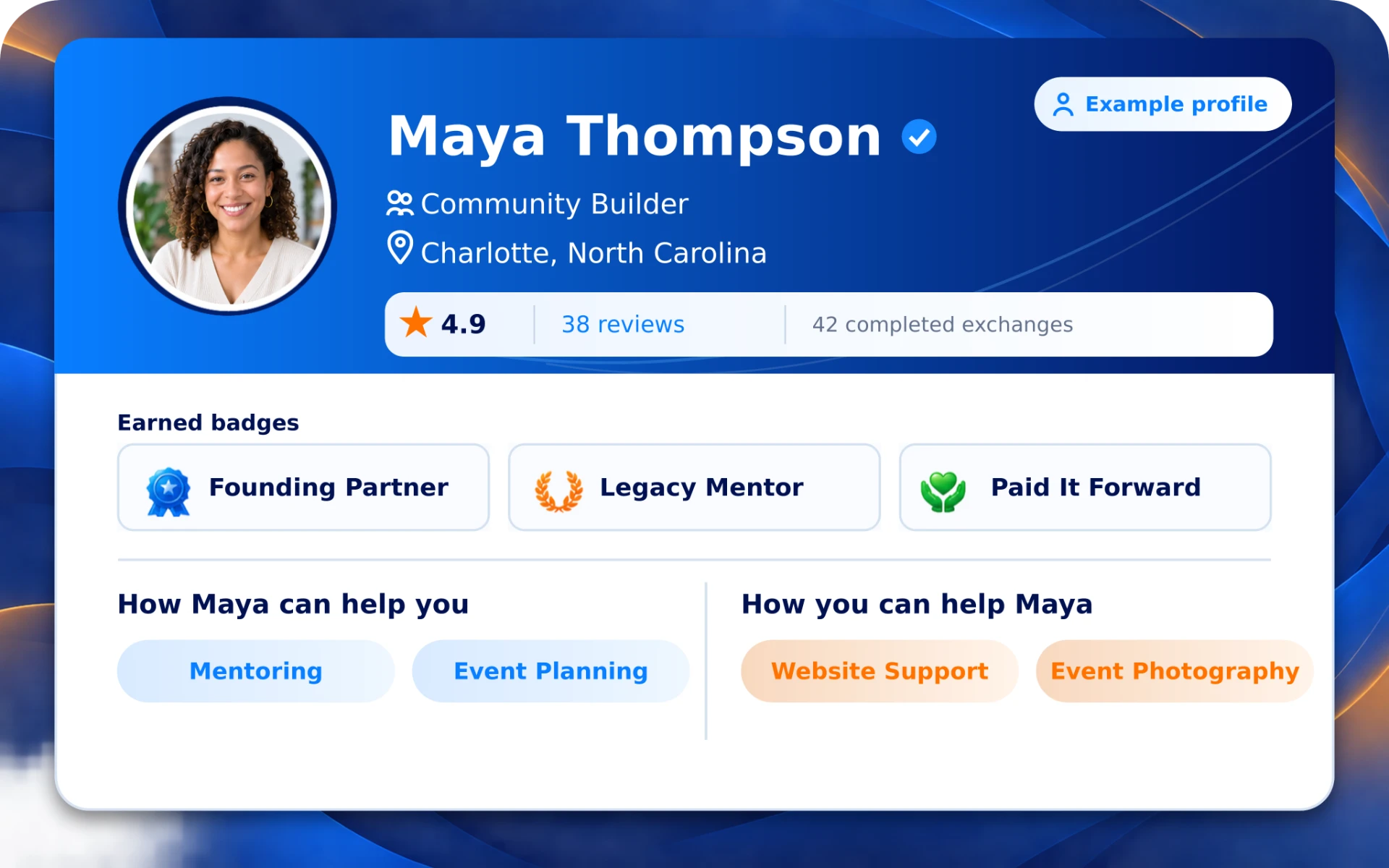
Trust & relationships
Your profile is more than a bio — it's a chance to show up, build trust, and attract the right connections.
Read article — Your Community Profile: Let Your Actions Introduce YouSee how it works
Communities, Events & Opportunities
How people find local groups, gatherings, and ways to take part.
See how it works